Head office: 316 Le Van Sy, Tan Son Hoa Ward, Ho Chi Minh City, Vietnam
 Hotline : 0911 888 247 - 0888 999 247
 Email : info@247power.vn

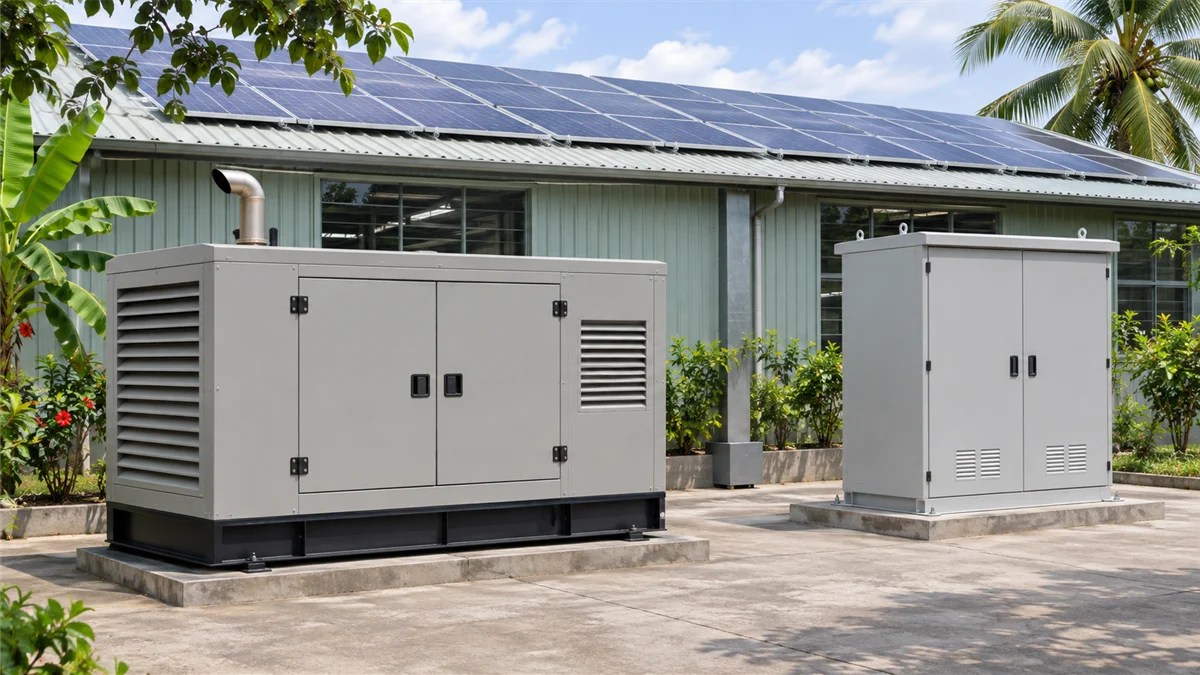
A hybrid generator system in this guide combines a diesel generator, photovoltaic panels and battery storage. Solar power can serve loads and charge the battery, the battery can discharge to cover a shortfall, and the generator can supply power when the other sources fall short. A controller coordinates the equipment according to the system’s operating design.
What equipment makes up a hybrid generator system?
“Hybrid” describes how power sources work together across the system. In an AC-coupled configuration, the solar equipment, battery and generator exchange power with the loads through an alternating-current bus in the distribution switchboard. Each branch serves a distinct purpose.
| Equipment | Role in an AC-coupled configuration |
|---|---|
| Photovoltaic (PV) panels and solar inverter | The inverter converts direct current from the PV panels into alternating current for the AC bus. |
| Battery storage and bidirectional converter | During charging, the converter takes AC power from the bus and converts it to DC for the battery. During discharge, it converts DC from the battery into AC to supply loads. |
| Diesel generator | Supplies AC power through its switchgear when called to run and the conditions for connecting to the bus have been met. |
| Controller, switchgear and protection | The controller monitors demand, output from the sources and the battery’s state of charge. The switchgear provides switching and protection as designed. |
How do the solar array, battery and generator connect?
Think of the AC bus as the common point for the supply and load branches. Power from the rooftop array reaches the bus through the solar inverter. The battery connects to the bus through a bidirectional converter, while the generator connects through its own switchgear. If the site has utility power, the grid connection point needs switchgear and protection suited to the operating modes. This describes the functions at the level of a conceptual one-line diagram.
When sunlight is available, the system can use PV output to serve running loads. If there is surplus power and the battery can accept it, the surplus can charge the battery. When clouds pass or demand rises, the battery can cover a shortfall within its power and state-of-charge limits. In island mode, if the battery is full or cannot absorb all the surplus, the controller can ask the inverter to reduce PV output.
The controller can call the generator when the shortfall exceeds what the battery can supply or when the state of charge reaches a configured threshold. Depending on the configuration and the capacity left after serving loads, the generator may also supply power to charge the battery through the converter. If the generator is to close onto an energised bus and run in parallel, the system must check synchronisation conditions before closing. See the guide to generator synchronisation for more on this principle.
Can solar keep supplying loads when the grid goes down?
That depends on the system’s islanding design. When entering island mode, the on-site power system must disconnect from the utility grid. A suitable source, such as a running generator or a grid-forming battery converter, establishes the voltage and frequency of the local bus. A compatible PV inverter can then supply power once it meets the system’s operating conditions. A conventional grid-tied inverter stops producing power during an outage if there is no suitable system to sustain a local grid.
247Power’s assessment
For factories in Vietnam that already have rooftop solar and a standby generator, start by identifying which loads must stay powered and how long they can tolerate an interruption. Give the engineer the existing switchboard drawings, inverter documentation and generator details so they can identify where to disconnect from the grid, which source will form the local grid and how the system will transfer between modes. With the same solar array and battery cabinet, coverage during an outage still depends on which loads are connected to the part of the system that can run in island mode.
To learn about the diesel branch specifically, see 247Power’s industrial generator catalogue and its generator design and installation services.
Frequently asked questions
Can an existing diesel generator be used in a hybrid system?
Yes, provided that the generator, switchgear and controls are compatible with the operating design. An engineer needs to check the generator’s start and stop signals, the transfer or parallel synchronisation mode, and its ability to supply the planned loads.
Does the diesel generator have to run throughout a grid outage?
In a configuration that allows diesel-off operation, the system can use the battery and solar array to serve loads when sufficient power and energy are available and suitable grid-forming equipment is in place. The controller can bring the generator back online when required to meet demand.
Photo: Minh họa (AI illustration)
Written by the 247Power editorial team with the help of AI tools. Figures were checked against the sources above. The assessment section is 247Power’s opinion.